About the Hammock Hypothesis
The Hammock Hypothesis (Lin's Biomechanical Balance Theory) models the face as one interconnected hammock: bone is the pillar, ligaments the ropes, fascia and skin the cloth, and fat pads and muscles the load lying within.
Origin and definition
The Hammock Hypothesis—formally Lin's Biomechanical Balance Theory—is a biomechanics-based conceptual framework for assessing facial aging and sequencing treatment.
Developed by Dr. Jui-Yu Lin and colleagues through clinical observation and biomechanical research, the framework was formally published in peer-reviewed literature. It models the facial soft-tissue system as a hammock of pillars, ropes and cloth: bone provides geometric support; ligaments and fascial septa anchor; facial and masticatory muscles transmit dynamic load; fat pads and skin are the visible surface. Facial aging is thus understood as a chain reaction across multiple layers, not the isolated laxity of a single tissue.

In balance, support, anchoring and load offset one another and the contour remains firm and lifted; degradation at any link propagates through the system.
The mechanical framework: four dimensions
The core paper describes facial aging through four interdependent dimensions, a continuous chain from deep structure to surface appearance.
| Dimension | Anatomical basis | Manifestation of imbalance |
|---|---|---|
| I · Foundational support | Bone projection and deep fat pads | Bone resorption lowers support and alters facial geometry |
| II · Anchoring restraint | Ligaments, fascial septa | Ligament laxity and attachment loosening displace tissue |
| III · Load redistribution | SMAS, facial and masticatory muscles | Muscle imbalance and heavy fat pads concentrate local load |
| IV · Surface deformation | Skin and dermis | Lost elasticity, rhytides and contour laxity—the visual endpoint of deep imbalance |
The governing relation is: upward support + anchoring force > downward load yields a young, firm, lifted face; the reverse produces visible sagging. Assessment must therefore cover both static support and dynamic load, not only surface signs.
Clinical implication
The framework's value is converting a "fill what is hollow" approach into an integrated reading of structure, restraint, dynamic load and skin quality: rebuild deep support and anchoring first, then address volume and surface detail, and sequence treatment by each patient's layer of imbalance. See the peer-reviewed papers below for operative principles and individualised planning.
Peer-reviewed publications
| Year | Paper and source | Contribution |
|---|---|---|
| 2026 | Lin C-Y, Lin J-Y, Frank K, et al. The Hammock Hypothesis: An Integrative Conceptual Framework for Facial Aging. Dermatological Reviews, 7, e70085. DOI: 10.1002/der2.70085 | An integrative facial-aging framework across support, anchoring, load transfer and surface dimensions. |
| 2025 | Lin C-Y, Lin J-Y, Frank K, et al. A Systemic Approach to Aging and Anti-Aging Interventions: A Mini-Review. Journal of Surgery, 10, 11344. DOI: 10.29011/2575-9760.011344 | Reviews aging and integrated intervention across seven systems: bone, fat, muscle, nerve, vessel, connective tissue and skin. |
| 2024 | Lin J-Y, Lin C-Y. The AestheCode System: A Safe and Efficient Guide for AestheFill Injection. Aesthetic Plastic Surgery. DOI: 10.1007/s00266-024-04250-4 | Systematises treatment zone, injection layer, instrument and dose, emphasising safety and individualisation. |
Full core paper
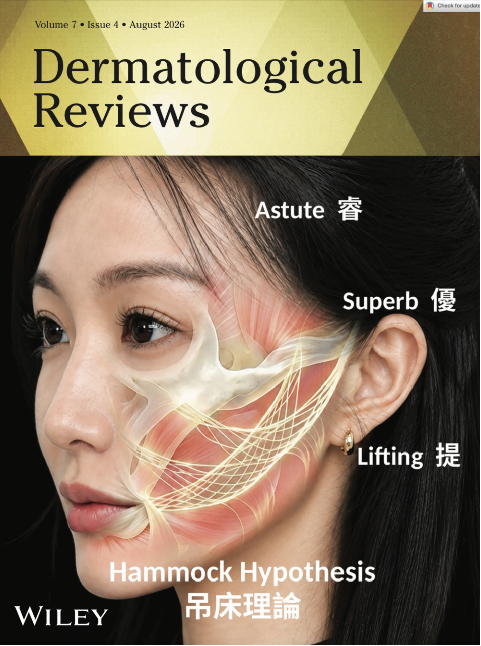 Peer-reviewed in Wiley's Dermatological Reviews, with the complete framework and clinical inference.Read the full paper →
Graphical abstract · 9 languages
The journal's official graphical abstract, with 9 full-resolution language versions.View the graphical abstract →
Further reading
The five-section illustrated treatise is in the academic theory article →; dynamic demonstration is in animation →.